A general model can know the language of an industry. That does not mean it can operate inside the industry.
Vertical AI is often marketed as a specialised prompt, a tuned model or a chat interface loaded with domain documents. That can improve usefulness. It is not enough for high-consequence professional work.
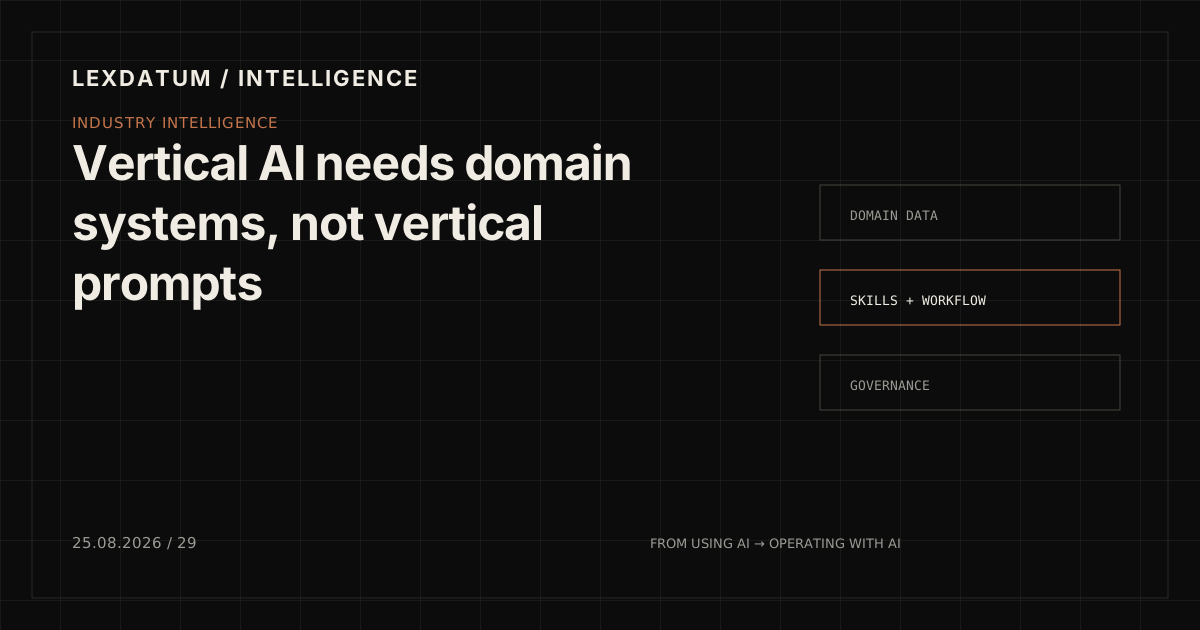
Google’s August 2026 launches for financial services and legal make an important distinction. In both cases, the argument is that foundational model intelligence needs to be surrounded by domain skills, secure connections to systems and data, agents that act inside real workflows, and governance underneath the whole stack.
The two industries are different, but the architecture generalises.
Domain truth lives outside the model
A financial model may know how a credit memo is structured. It does not know:
- today’s licensed market data;
- the institution’s risk appetite;
- the approved valuation model;
- the current client mandate;
- restricted-list status;
- the exact data lineage used in a decision.
A legal model may know contract language. It does not know:
- matter-specific confidentiality walls;
- the firm’s playbook;
- which precedent is authoritative internally;
- current matter permissions;
- jurisdiction-specific workflow;
- whether a human lawyer has approved the output.
Domain expertise therefore has two forms:
knowledge and institutional context.
Models provide some of the first. Enterprises must supply and govern the second.
Skills should encode repeatable professional method
A domain skill is more than a prompt template.
A useful skill can define:
- inputs;
- authoritative sources;
- calculations;
- policy constraints;
- tool sequence;
- expected evidence;
- review requirements;
- output structure;
- escalation conditions.
For example, a “contract deviation review” skill might retrieve the approved playbook, compare clauses, classify deviations, cite each source paragraph and route high-risk issues to counsel.
The skill captures method, not merely wording.
Permissions are domain logic
In professional services, access is rarely a simple departmental role.
Legal matters can have ethical walls. Financial data can be restricted by client, desk, jurisdiction or information barrier. Healthcare records can depend on care relationship and purpose. Manufacturing systems can distinguish plant, line and safety role.
The agent must inherit these boundaries without flattening them.
That means domain AI architecture needs first-class identity, row/document-level access, delegated authority and auditable policy decisions.
A brilliant answer obtained from data the user should not have seen is still a system failure.
Workflow integration determines value
Vertical AI becomes economically interesting when it can participate in the work system.
Examples:
- create a draft inside the matter workspace;
- enrich a deal record;
- prepare an exception package;
- update a controlled case status;
- request approval;
- create evidence for audit;
- trigger a downstream workflow after verification.
Without integration, professionals copy and paste between the AI and the system of record. That may save time but preserves friction and weakens auditability.
The jump from “vertical assistant” to “vertical system” happens at the workflow boundary.
Governance should be domain-specific too
Generic safety policy is necessary but insufficient.
Financial workflows may need model risk management, record retention and data-lineage evidence. Legal work may require confidentiality, privilege and explicit professional review. Healthcare may require clinical validation and constrained use. Public-sector workflows may need transparency and appealability.
The governance layer should understand the consequences of the domain action.
Build a reusable horizontal core
Verticality does not mean rebuilding the entire AI platform for each sector.
A strong architecture keeps reusable horizontal infrastructure:
- identity;
- model gateway;
- tool protocol;
- tracing;
- evaluation;
- budgets;
- policy engine;
- observability.
Then it adds vertical packages:
data contracts + skills + systems + controls + workflows.
That combination is faster to scale and easier to govern.
The Lexdatum view
The moat in vertical AI will not be a longer industry prompt.
It will be the ability to encode how a profession actually works: what counts as truth, who may see it, which steps must happen, which evidence must remain and where human judgement cannot be delegated.
The model supplies intelligence.
The domain system makes that intelligence employable.
Sources
- Google Cloud — Now introducing Gemini Enterprise for Financial Services (2026-08-25)
- Google Cloud — Now introducing Gemini Enterprise for Legal (2026-08-25)
Research note: This analysis is based on public information available on 1 September 2026. Product capabilities, prices and regulatory interpretations can change. Vendor-reported claims are identified as such. This is not legal, security, financial or investment advice.