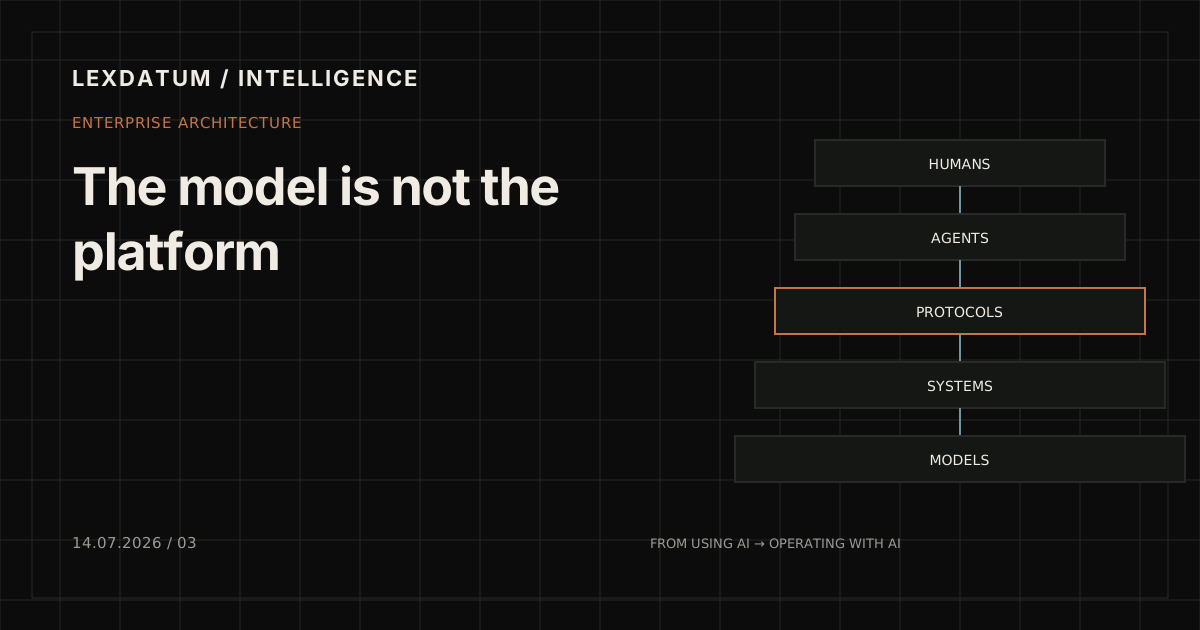
Claude’s availability through Google Cloud illustrates a broader shift: frontier intelligence is increasingly consumed through enterprise control planes.
Google Cloud’s July description of running Claude at scale makes a point that matters beyond Anthropic or Google: enterprise adoption is separating the intelligence layer from the operating platform.
The model supplies reasoning, language and tool-selection capability. The platform supplies identity, networking, observability, regional controls, capacity, billing and the operational conventions that let a company run the model alongside the rest of its estate.
Why this distinction matters
A model benchmark can influence a prototype. It cannot, by itself, determine a production architecture.
Large organisations must answer a different set of questions. Can prompts and intermediate state remain within an approved geography? Does access inherit existing IAM? Can traffic stay behind private network controls? Are logs available to security operations? Can capacity survive a regional incident? Can the same deployment process support more than one model family?
Google says Claude calls on Vertex AI can use the same IAM, VPC controls and observability as other Google Cloud services, with regional and multi-region endpoints for data-residency and resilience requirements. Those capabilities are not glamorous, but they are often what turns access to a frontier model into an enterprise service.
Model choice is temporary
The best model for a task can change several times during the life of the workflow. Performance improves, prices move, context windows expand, safety policies evolve and providers release specialised variants.
An architecture that embeds one model deeply into every business rule creates switching costs in the wrong place. A better design separates:
- the business workflow and deterministic rules;
- the context and retrieval layer;
- tool contracts and permissions;
- model-specific prompts and adapters;
- evaluations that define acceptable behaviour;
- routing logic based on quality, latency, cost and policy.
This does not create magical vendor independence. Providers expose different capabilities, semantics and operational constraints. Some migration work will always remain. The goal is pragmatic replaceability: changing a model should not require redesigning the process, identity model and audit trail at the same time.
The control plane becomes strategic
As models become more interchangeable, the surrounding control plane captures more of the durable value.
That control plane includes:
Identity. Which user or service principal authorises an action?
Network. Can the model reach an internal system without exposing it publicly?
Data boundary. Where are prompts, outputs, caches and intermediate artefacts processed?
Observability. Can teams inspect latency, tool calls, failures, costs and policy decisions?
Evaluation. Is a model upgrade tested against real acceptance criteria before traffic moves?
Resilience. What happens when a region, provider or specific model endpoint is unavailable?
These are architectural choices, not procurement footnotes.
One model, many deployment paths
The same underlying model may be available through a direct API, a hyperscaler marketplace, a managed AI platform or a private arrangement. Each route can create different terms, feature timing, regional availability, support models and security integrations.
Therefore, “we use Model X” is an incomplete technical statement. Leadership needs to know how Model X is accessed, under which controls, with what fallback, and where data flows.
For regulated or operationally critical use cases, the access route can matter as much as the model.
A practical decision framework
Before standardising a deployment path, compare options across:
- task quality measured on the organisation’s own evaluations;
- supported tool use and structured outputs;
- latency distribution, not only average latency;
- regional processing and retention terms;
- identity and private-network integration;
- observability and audit evidence;
- capacity commitments and failure handling;
- total cost, including orchestration and human review;
- portability of prompts, tools and stored state.
The cheapest token price may produce the most expensive workflow if it requires more retries, review or custom infrastructure.
The Lexdatum view
Enterprises should avoid both extremes: pretending every model is interchangeable, and allowing one provider to become the architecture.
The durable design principle is simple: models are components; the operating system around them is the asset.
A model-agnostic strategy is not a logo wall. It is a tested abstraction layer, a common evaluation suite, explicit data boundaries and the ability to route each class of work to the intelligence that serves it best.
Sources
- Google Cloud — Claude at scale on Google Cloud: Frontier AI, built for enterprise production (2026-07-14)
Research note: This analysis is based on public information available on 31 August 2026. Product capabilities, prices and regulatory interpretations can change. Vendor-reported metrics are identified as such. This is not legal, security or investment advice.