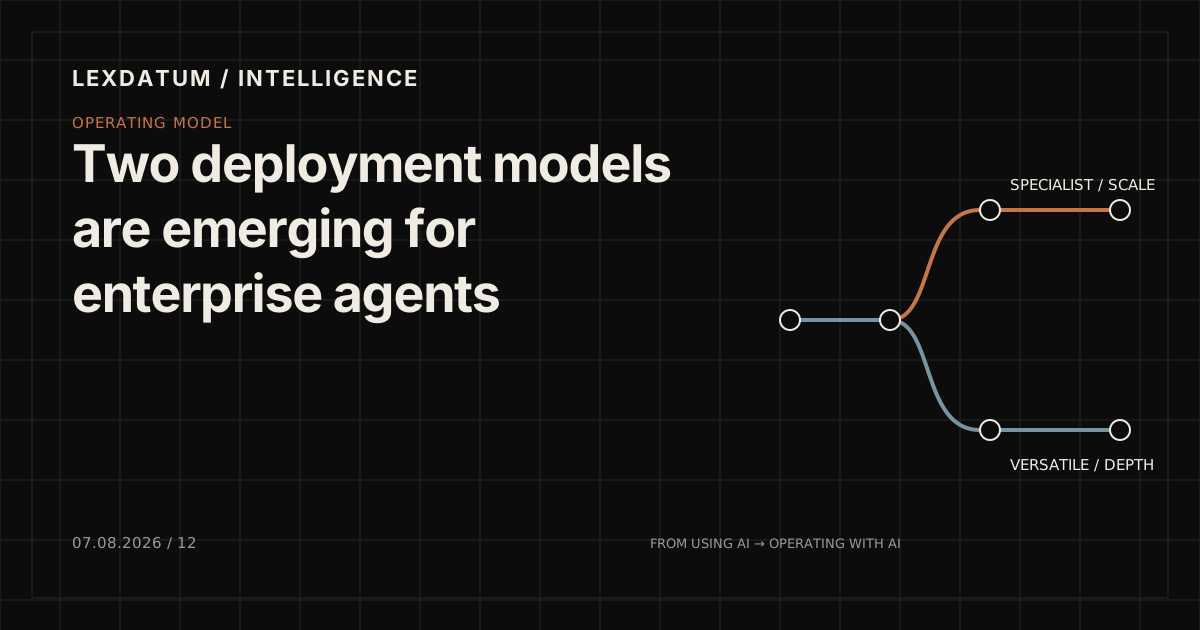
Salesforce platform data suggests a split between high-volume specialist agents and versatile multistep systems. Architecture should follow operational DNA.
Salesforce’s 2026 Agentic Enterprise Index, based on aggregated usage of its Agentforce platform, describes two patterns in enterprise deployment.
Consumer-facing sectors tend towards high-volume, task-specific agents built for speed and repetition. More operationally complex or regulated environments tend towards versatile, multistep agents that navigate broader business logic. Salesforce reports particularly rapid growth in retail activity on its own platform.
The dataset is vendor-specific and should not be treated as a census of the global market. The split is nevertheless a useful strategic lens.
Pattern one: the specialist at scale
A specialist agent has a narrow job, high request volume and a small action surface.
Examples include:
- answering order-status questions;
- resetting an account after verification;
- classifying incoming service cases;
- checking return eligibility;
- booking a known type of appointment;
- extracting a standard document.
The economics depend on throughput, latency and consistency. The architecture should minimise context, restrict tools and optimise the common path. A deterministic workflow around a smaller model may outperform a sophisticated general agent.
The principal risks are repetitive errors at scale, poor edge-case handling and hidden customer harm. Small error rates become large incident volumes when the agent runs millions of times.
Pattern two: the versatile operator
A versatile agent handles fewer tasks but coordinates multiple systems and steps.
Examples include:
- investigating a production exception;
- preparing a complex procurement case;
- coordinating a public-sector request across departments;
- assembling evidence for a regulated decision;
- supporting a manager with cross-functional planning.
The economics depend less on raw volume and more on cycle-time reduction, expert leverage and successful completion of complex cases.
This architecture requires richer context, durable state, more tools, deeper policy and stronger oversight. It is also more difficult to evaluate because valid paths can differ.
Do not confuse breadth with maturity
A broad agent is not inherently more advanced than a narrow one. Maturity means that the system’s scope matches its controls.
A specialist can be highly autonomous inside a tiny, reversible boundary. A versatile operator may remain mostly advisory because its decisions cross financial, legal or safety domains.
The right unit is the authority envelope:
- what the agent can perceive;
- which tools it can invoke;
- which state it can change;
- the maximum consequence of one action;
- the conditions that require escalation.
An agent with broad knowledge and narrow execution rights may be safer than one with limited knowledge and unrestricted write access.
Portfolio architecture beats one flagship agent
Large companies will probably need both patterns.
Customer service, ecommerce and employee support may justify high-volume specialists. Finance, manufacturing, legal and strategic operations may need versatile case workers. Trying to force every domain into one “enterprise super-agent” creates an impossible context, permission and evaluation problem.
A portfolio should share common infrastructure:
- identity and delegated authority;
- tool registry and capability contracts;
- tracing and audit;
- evaluation and release controls;
- model routing;
- incident response;
- human approval patterns.
Domain teams can then choose the appropriate agent shape without inventing governance from scratch.
Metrics must differ by pattern
For specialist agents, track throughput, error rate, containment, repeat contact, latency and unit cost.
For versatile operators, track cycle time, completion rate, expert hours avoided, quality of evidence, correct escalation and downstream rework.
Using “number of conversations” or “agent adoption” as universal success metrics obscures whether the system creates business value.
The Lexdatum view
Enterprise agent strategy should not begin with a platform catalogue. It should begin with the organisation’s operational DNA.
High-volume work rewards constraint and efficiency. Complex case work rewards context, orchestration and controlled flexibility. Both require governance, but they require different runtimes, evaluations and economics.
The objective is not one agent for the enterprise. It is a governed portfolio of delegated capabilities.
Sources
Research note: This analysis is based on public information available on 31 August 2026. Product capabilities, prices and regulatory interpretations can change. Vendor-reported metrics are identified as such. This is not legal, security or investment advice.