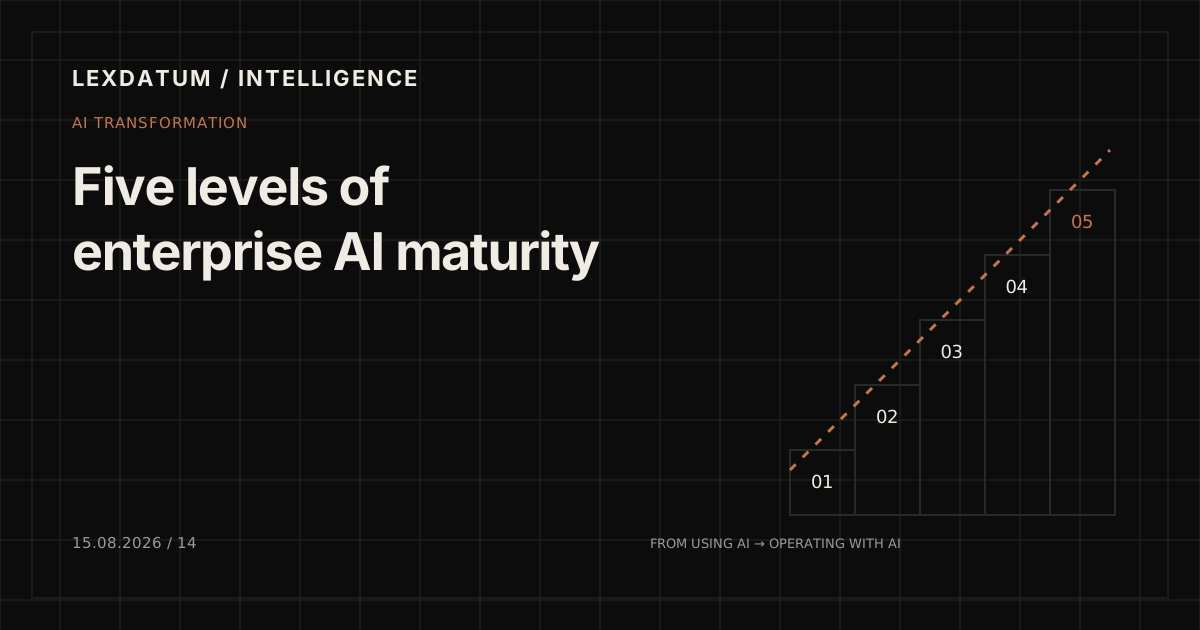
A Lexdatum framework for distinguishing personal assistance from connected, automated, agentic and AI-native operations.
Many organisations describe themselves as “advanced in AI” because employees use copilots every day. Others have built a sophisticated model platform but changed few business processes. A single maturity score can hide these differences.
Lexdatum’s five-level framework separates access to intelligence from the ability to operate with it.
Level 1 — Assisted
Individuals use general AI interfaces to write, summarise, analyse, translate or prepare meetings.
Value is real but mostly personal. Knowledge and prompts remain fragmented. Results depend on individual practice. Governance focuses on approved tools, data handling and basic literacy.
Evidence of maturity: adoption, safe-use guidance, role-specific training and measurable time saved on bounded tasks.
Common trap: treating licence activation as transformation.
Level 2 — Connected
AI gains controlled access to departmental knowledge and systems. It can retrieve approved documents, query selected data and appear inside existing workflows.
The organisation begins to build a context layer: permissions, metadata, source quality and retrieval. Value shifts from generic generation to company-specific assistance.
Evidence of maturity: source-grounded answers, permission-aware access, improved search and reduced time spent locating information.
Common trap: connecting every repository before defining which decisions the system should improve.
Level 3 — Automated
AI participates in repeatable end-to-end workflows. It classifies, extracts, drafts, validates and calls tools while deterministic software controls the sequence and side effects.
The unit of value is no longer a better answer. It is a completed process with less manual work.
Evidence of maturity: cycle-time reduction, lower rework, consistent handling and clear exception queues.
Common trap: labelling a chain of prompts as autonomous while humans still repair its failures invisibly.
Level 4 — Agentic
Agents receive goals, choose among approved tools, maintain state, coordinate tasks and act inside explicit authority envelopes. Human checkpoints are designed into the runtime. Evaluations test full execution traces.
At this level, identity, observability, policy and incident response become strategic infrastructure. Agents may operate continuously or across several days.
Evidence of maturity: verified outcomes, correct escalation, traceable actions, controlled autonomy and resilient long-running execution.
Common trap: granting broad tool access before the organisation can detect and contain anomalous behaviour.
Level 5 — AI-native
The organisation redesigns products, services and its operating model around intelligence that can be delegated. Human and machine roles are allocated deliberately. New processes become economically possible because analysis and execution can occur at much lower marginal cost.
AI-native does not mean “fully autonomous”. It means the organisation knows where human judgement creates value and where software should act.
Evidence of maturity: new revenue or service models, redesigned operating structures, reusable capability platforms and continuous model/evaluation improvement.
Common trap: confusing maximal autonomy with strategic advantage.
Maturity is multidimensional
An organisation may sit at Level 4 in software engineering and Level 1 in procurement. It may have strong architecture and weak adoption, or excellent data and no operational ownership.
Assessment should therefore score several dimensions:
- opportunity and process clarity;
- data and enterprise context;
- integration and tool design;
- model and evaluation capability;
- identity, security and governance;
- operating ownership and change;
- economics and measurement.
The lowest dimension often determines how far a use case can progress safely.
The right next step depends on the level
A Level 1 organisation does not need a multi-agent platform first. It needs governed access, literacy and a high-value connected workflow.
A Level 2 organisation should convert retrieval into action through a narrow process.
A Level 3 organisation should standardise identity, trace and evaluation before expanding autonomy.
A Level 4 organisation should build a portfolio operating model, common runtime and incident capability.
A Level 5 organisation should continue questioning where intelligence changes the product, not merely the cost base.
A board-level maturity test
Ask five questions:
- Can AI access authoritative context under the same permissions as the user?
- Can it execute a useful process rather than only recommend?
- Can we inspect every consequential tool call and policy decision?
- Can the system stop, escalate and recover safely?
- Has AI changed what the business can offer, not only how quickly staff write?
The first “no” indicates the next architectural frontier.
The Lexdatum view
Maturity is the distance between using AI and operating with AI.
The aim is not to push every function to Level 5. It is to choose the appropriate level for each workflow and build the controls that make that level dependable.
A payroll change and a marketing draft should not have the same autonomy. A good operating model accepts that difference and makes it explicit.
Sources
- OpenAI — From assistance to execution: How enterprises put AI to work (2026-08-12)
- Google Cloud — 20 questions for the Agentic Enterprise (and how Agent Platform can help) (2026-07-07)
Research note: This analysis is based on public information available on 31 August 2026. Product capabilities, prices and regulatory interpretations can change. Vendor-reported metrics are identified as such. This is not legal, security or investment advice.