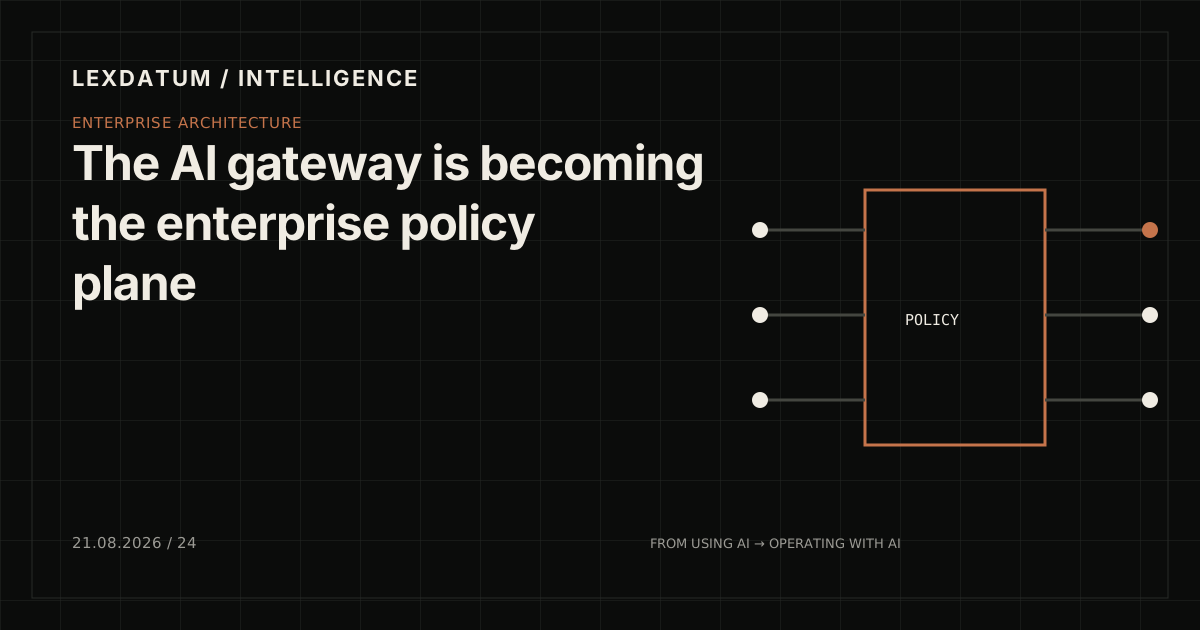
The enterprise abstraction is moving up one level: from “which model endpoint?” to “which governed AI service?”
A multi-model estate becomes messy faster than most architecture diagrams suggest. Different teams bring different providers. Coding agents carry their own clients. MCP servers expose tools. Some workloads need European processing, others need a private endpoint, and others simply need the cheapest model that passes an evaluation threshold.
If every application embeds its own provider keys, retries, safety filters, logging and budgets, AI infrastructure fragments.
Databricks’ 2026 Unity AI Gateway documentation is one example of the alternative: route model and MCP traffic through a common layer that can apply privileges, rate limits, budgets, fallbacks, policies and observability across external and hosted providers.
The important concept is not the product. It is the policy plane.
Separate model choice from application identity
An application should ideally ask for a governed service:
contract-analysis-prod
rather than directly hard-coding:
provider/model/version
That service can define:
- permitted destinations;
- fallback order;
- regional constraints;
- budgets;
- rate limits;
- content or data policies;
- telemetry;
- evaluation requirements.
The application keeps a stable contract while the platform team can change the implementation underneath.
This is how falling model prices and new models become exploitable without rewriting every business application.
MCP makes the gateway broader than inference
Once agents can call MCP services, the control problem is no longer limited to model requests.
A platform must answer:
- Which agents may discover this MCP server?
- Which tools may they invoke?
- At what rate?
- Under which policy?
- Can a destructive call require approval?
- What was returned?
- Which downstream system was affected?
Databricks now documents policies that can allow, deny or require human approval around MCP tool calls, plus service-level usage telemetry.
That points toward an integrated control plane for reasoning and action.
Provider credentials should stop leaking into every client
Central routing also improves credential architecture.
Instead of distributing API keys to every developer tool and application, the gateway can hold provider credentials and authorise the calling principal against an internal service.
This creates cleaner rotation, offboarding and auditability. It also makes it possible to distinguish:
who may use AI from which external account implements the service.
Those are different concerns and should not be collapsed into one secret.
Budgets and availability belong in routing
A mature gateway should combine technical and economic policy.
For example:
- route normal traffic 80/20 across two approved destinations;
- fail over on 429 or 5xx errors;
- cap a department’s monthly spend;
- restrict high-cost models to approved workflows;
- use lower-cost models for routine coding tasks;
- keep regulated workloads inside an approved geography.
The gateway becomes the place where platform intent is executable.
But that power creates a new critical dependency.
The gateway must not become an opaque chokepoint
Centralisation can fail if the gateway is slow, proprietary or impossible to inspect.
Enterprise requirements should include:
- clear latency overhead;
- high availability;
- exportable telemetry;
- configuration as code;
- policy versioning;
- predictable failure behaviour;
- bypass or degraded modes for critical services;
- portability of routing and policy logic where feasible.
A control plane should reduce vendor lock-in, not merely move it one layer up.
A useful architectural split
Lexdatum tends to separate four concerns:
Application layer
Business interfaces, agents and workflows.
AI policy plane
Identity, routing, budgets, guardrails, evaluations and telemetry.
Capability layer
MCP tools, enterprise APIs, retrieval and software actions.
Provider/runtime layer
Models, sandboxes, compute and third-party services.
That separation lets each layer evolve at a different speed.
The Lexdatum view
The strategic asset in enterprise AI is increasingly not a single model contract. It is the governed path through which intelligence and tool use enter the organisation.
An AI gateway can become that path if it stays model-agnostic, observable and policy-rich.
The model remains replaceable. The policy plane becomes institutional infrastructure.
Sources
- Databricks — AI governance with Unity AI Gateway (2026-08-21)
- Databricks — AI governance guide (2026-08-21)
Research note: This analysis is based on public information available on 1 September 2026. Product capabilities, prices and regulatory interpretations can change. Vendor-reported claims are identified as such. This is not legal, security, financial or investment advice.