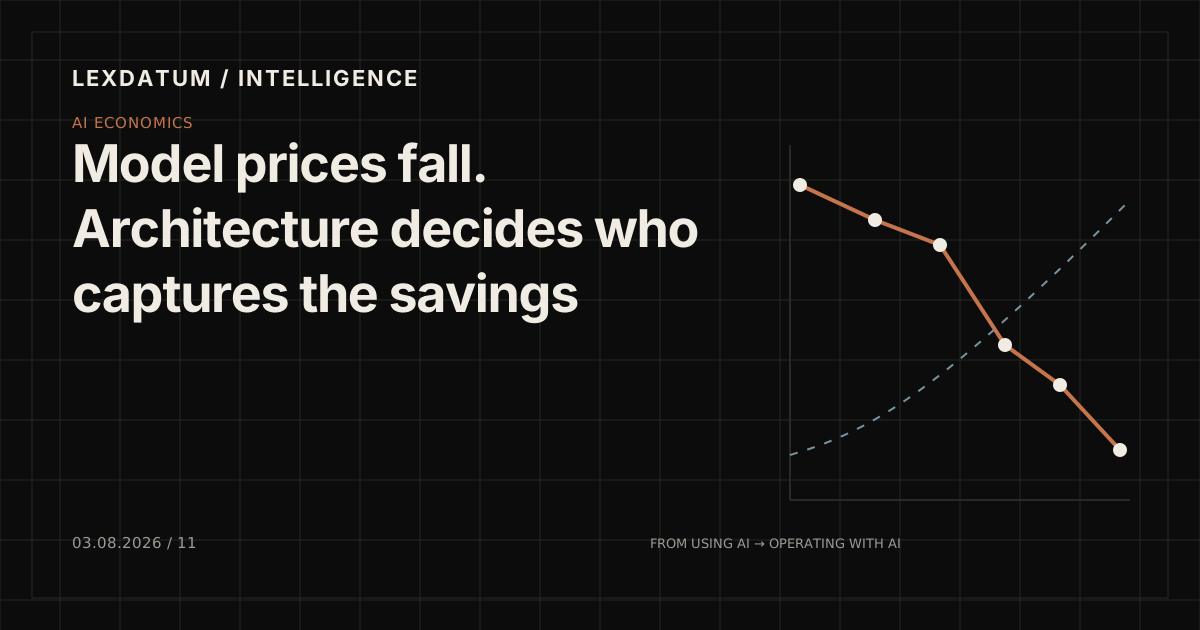
An 80% price cut for one GPT‑5.6 tier on Amazon Bedrock shows why model cost should be routed, measured and treated as a moving input.
AWS reported that on-demand inference prices for GPT‑5.6 Luna on Amazon Bedrock fell by 80% from 30 July, while GPT‑5.6 Terra prices fell by 20%. AWS listed Luna at $0.20 per million input tokens and $1.20 per million output tokens.
The specific prices will continue to change. The strategic lesson is more durable: model economics are moving too quickly to be hard-coded into one architecture or one annual business case.
A cost reduction is not automatically a business saving
If a workflow is tightly coupled to a premium model, a cheaper alternative may exist without being usable. The prompts may rely on provider-specific behaviour. Tool schemas may not be portable. Evaluations may be absent. Procurement may have approved only one route. The system may not expose enough telemetry to know which tasks need expensive reasoning.
In that situation, market price reductions remain theoretical.
An organisation captures savings when it can:
- measure cost per business outcome;
- classify workloads by difficulty and consequence;
- switch or route models safely;
- validate quality before moving traffic;
- exploit caching and batch execution;
- replace predictable reasoning with deterministic code;
- control retries and agent loop length.
Cost optimisation is an architecture capability.
Token price is only the beginning
The cheapest model per token can be expensive in production if it produces more rejected outputs, takes longer, calls more tools or creates more human review.
A complete unit cost includes:
Inference — input, output, audio, image and reasoning charges.
Context — retrieval, embeddings, vector or search services, caches and data transfer.
Execution — tool calls, sandboxes, browsers, APIs and workflow infrastructure.
Assurance — evaluations, secondary models, observability and human review.
Failure — retries, reversals, customer recovery and operational risk.
The relevant denominator is a verified business outcome, not one million tokens.
Build a routing hierarchy
A mature enterprise workload can use several levels:
- No model. Rules, SQL, templates or conventional software solve deterministic steps.
- Small or specialised model. Classification, extraction and high-volume transformations.
- General frontier model. Complex synthesis, tool selection and ambiguous knowledge work.
- High-effort reasoning. Difficult exceptions with enough value to justify the cost.
- Human decision. Consequential, novel or poorly evidenced cases.
The routing decision should consider policy as well as price. Some data or jurisdictions may permit only certain deployment routes. A low-cost model is irrelevant if it cannot meet the data boundary.
FinOps needs agent-level telemetry
Traditional cloud FinOps maps spend to services, teams and environments. Agentic systems require a finer unit.
Teams should be able to see:
- cost per agent, workflow and outcome;
- cost by model and tool;
- tokens consumed by retries or loops;
- cache hit rate;
- proportion of work sent to premium reasoning;
- human-review cost;
- spend caused by failed or abandoned tasks;
- changes after a prompt or model release.
Budgets and hard stops should be enforceable at runtime. An agent should not be able to “think longer” indefinitely because a prompt did not specify an exit condition.
Falling prices expand the feasible set
Cheaper inference does more than reduce an existing bill. It can make previously uneconomic workflows viable: reviewing a larger document set, running stronger evaluations, maintaining multilingual service or applying a second-pass verifier.
The best use of a price reduction may therefore be to improve reliability rather than simply lower spend.
Leadership should decide deliberately whether savings are returned to the P&L, reinvested in quality or used to automate more volume.
The Lexdatum view
Model prices are volatile inputs. Business processes should not be.
The organisations that gain from the price curve will be those with model abstractions, task-level evaluations and outcome-level cost telemetry. They can adopt a cheaper model when it is genuinely equivalent—and pay for stronger intelligence where it materially changes the result.
The future of AI economics is not “use the cheapest model”. It is allocate the right intelligence to each unit of work.
Sources
Research note: This analysis is based on public information available on 31 August 2026. Product capabilities, prices and regulatory interpretations can change. Vendor-reported metrics are identified as such. This is not legal, security or investment advice.